Centruroides sculpturatus is the only scorpion species in the Sonoran Desert capable of climbing vertical surfaces and delivering medically significant venom. Properties in Scottsdale foothills neighborhoods such as…
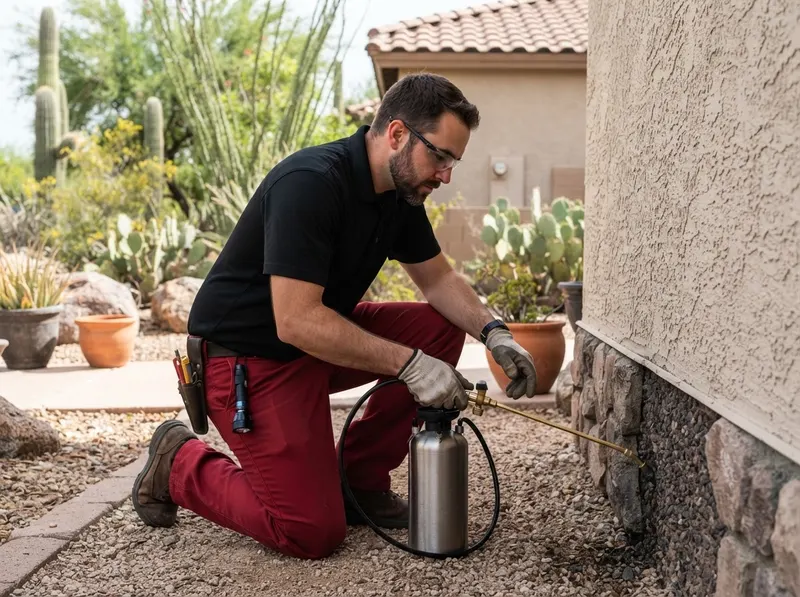
Centruroides sculpturatus is the only scorpion species in the Sonoran Desert capable of climbing vertical surfaces and delivering medically significant venom. Properties in Scottsdale foothills neighborhoods such as Troon North, Silverleaf, and Pinnacle Peak face continuous seasonal pressure due to their direct adjacency to the McDowell Sonoran Preserve. Desert washes, decorative riprap, and subterranean irrigation valves provide the high-humidity shelters scorpions require to survive the summer heat. Standard liquid insecticides fail against bark scorpions because their thick cuticles and raised bodies keep them elevated above standard surface residues. Effective remediation demands desert-formulated microencapsulated compounds that adhere directly to the pest's appendages as they navigate porous surfaces.
Eradication requires eliminating structural access points alongside the biological population. In golf-adjacent communities like Gainey Ranch and McCormick Ranch, dense perimeter landscaping and moist mulch beds provide steady insect food supplies, driving scorpions toward residential weep screeds and door thresholds. Bark scorpions require an opening of only 1.5 millimeters, the thickness of a credit card, to penetrate interior baseboards and reach living areas. Structural exclusion seals weeping weep screeds with copper mesh or breathable vents, caulks utility line entry points with elastomeric sealants, and applies specialized silica dusts into hollow block fence cores.
Decision guidance depends on property construction and surrounding topography. A standalone chemical exterior treatment fits newer tract homes in South Scottsdale or Old Town Scottsdale where natural desert wash corridors are absent. Properties bordering open desert in DC Ranch or McDowell Mountain Ranch require physical architectural exclusion combined with ultraviolet night remediation; the trade-off involves higher initial labor costs for sealing mortar joints and fence lines, but it removes the reliance on repeated bi-weekly chemical applications. Work follows a three-step method: first, an ultraviolet blacklight sweep measures the perimeter infestation density; second, microencapsulated barriers and dry insecticidal dusts are injected into structural voids; third, exterior entry gaps exceeding 1/16th inch are mechanically sealed against future re-entry.
Every job gets a firm, written price after a free on-site visit.
Tell us about your arizona bark scorpion eradication job in Scottsdale and we'll send a clear, written quote, usually the same day.
 Millstone Pest Control