Tick and flea infestations across Scottsdale yards stem primarily from brown dog ticks and cat fleas exploiting warm microclimates created by residential drip irrigation and shaded landscape designs. Properties…
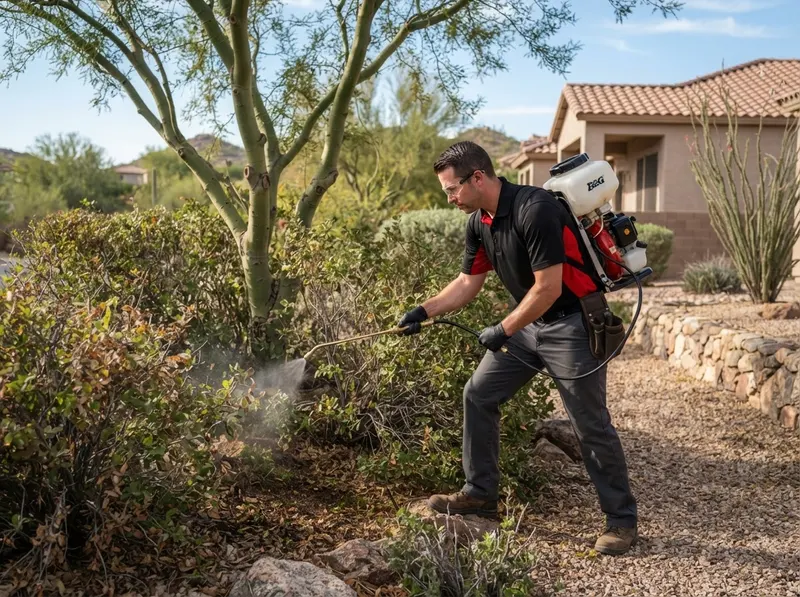
Tick and flea infestations across Scottsdale yards stem primarily from brown dog ticks and cat fleas exploiting warm microclimates created by residential drip irrigation and shaded landscape designs. Properties throughout McCormick Ranch and Gainey Ranch with mature vegetation, decomposed granite, and natural turf provide optimal ground moisture for flea larvae and tick nymphs. Untreated, brown dog ticks can complete their entire life cycle outdoors or crawl into interior baseboards and exterior wall voids. Targeted yard remediation disrupts this reproduction cycle by layering an insect growth regulator (IGR) with an exterior residual barrier, halting egg hatch rates and eliminating reproducing adults.
Treatment applications differ significantly based on Scottsdale ground surface types. Low-desert xeriscaping in Troon North, Silverleaf, and DC Ranch presents distinct harborage environments where decomposed granite retains heat while drip emitters beneath desert shrubs provide critical insect survival zones. A liquid microencapsulated adulticide holds up against intense ground temperatures without degrading prematurely under high UV index conditions. If an infestation is isolated to artificial turf runs, dedicated sanitizing rinses combined with low-drift pet-safe active ingredients eliminate organic waste pockets where flea pupae shelter. The trade-off between natural turf treatments and desert gravel beds is water volume: natural turf demands deep-root penetration washes, whereas desert rock borders require precise misting along stem bases, foundation stems, and perimeter block walls.
Edge cases involve native desert wildlife transitions near McDowell Mountain Ranch, Pinnacle Peak, and the McDowell Sonoran Preserve. Desert cottontails, javelinas, and coyotes frequent perimeter fencing, dropping secondary flea and tick populations directly against patio perimeters and outdoor kitchens. Remediation in these interface zones requires treated structural buffer strips of 3 to 6 feet along rear property fencing to intercept migrating parasites before family pets access outdoor spaces. Dwellings in South Scottsdale or Old Town Scottsdale with compact lots require close coordination with pet schedules, requiring animals to remain indoors until liquid barriers dry completely, which occurs within 45 to 60 minutes in typical Maricopa County ambient temperatures. Contact the service line at (888) 495-7652 to coordinate on-site acreage mapping.
Every job gets a firm, written price after a free on-site visit.
Tell us about your tick and flea yard remediation job in Scottsdale and we'll send a clear, written quote, usually the same day.
 Millstone Pest Control